ToxicAmanitaceae
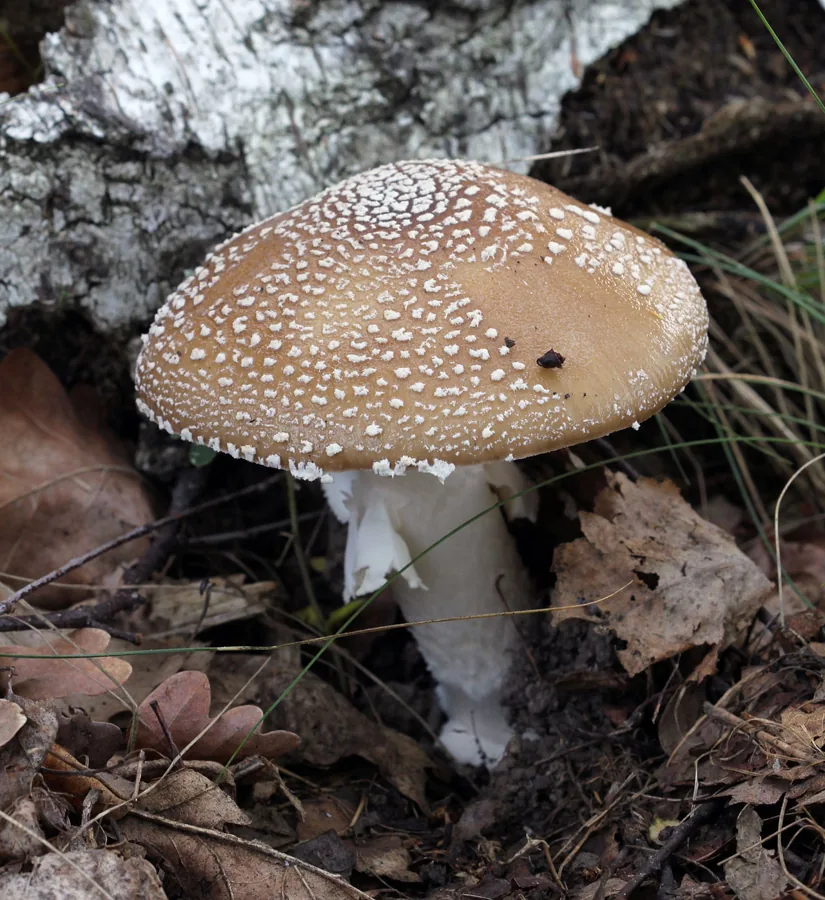
Amanita pantherina
Panther cap
Brown-capped relative of the fly agaric with a stronger and more dangerous dose of the same toxins.
- Cap
- Convex to flat, 5-12 cm, tan to dark brown with white warts and a grooved margin.
- Gills
- Free, white.
- Stem
- 60-130 mm, white with a ring and a distinctly rimmed bulbous base.
- Flesh
- White.
- Spore print
- White
- Habitat
- Deciduous and conifer woodland, especially beech and oak.
- Distribution
- Europe, Asia, North America.
- Season
- Summer to autumn.
- Bruising
- None.
- Odour
- Not distinctive.
Key features
- ▪Brown cap with pure white warts
- ▪Grooved cap margin
- ▪Rimmed bulbous base
Field tests
- White spore print rules out Psilocybe
Edibility
Toxic and sometimes fatal.
Warning
Contains more ibotenic acid and muscimol than fly agaric; poisonings are often severe.
Lookalikes
Amanita rubescens (the blusher)toxic
The blusher stains pink-red where damaged and has pinkish-grey patches; pantherina stays white-warted and does not redden.
Photo and feature-based identification is probabilistic. Never consume a wild mushroom on the basis of an app result — confirm with an experienced mycologist.