Deadly toxicCortinariaceae
Cortinarius rubellus
Deadly webcap
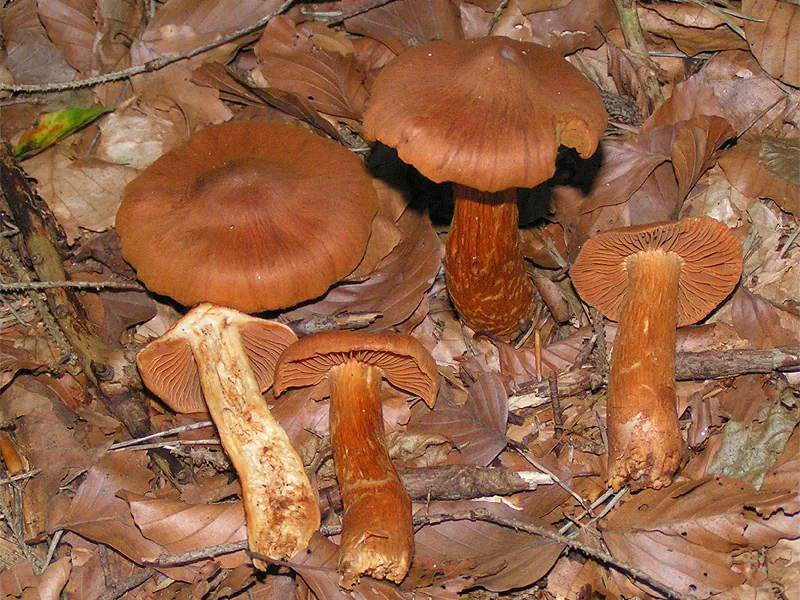
Orange-brown webcap whose toxin destroys the kidneys weeks after ingestion.
- Cap
- Conical to convex with a pointed umbo, 3-8 cm, foxy orange-brown, dry and fibrous.
- Gills
- Widely spaced, ochre then rusty.
- Stem
- 50-120 mm, tapering, with yellow girdle bands and remains of a cobwebby veil.
- Flesh
- Yellowish.
- Spore print
- Rusty brown
- Habitat
- Damp conifer woodland with spruce and pine, on mossy acidic ground.
- Distribution
- Northern Europe, North America, Asia.
- Season
- Late summer to autumn.
- Bruising
- None.
- Odour
- Faintly radish-like.
Key features
- ▪Rusty spore print
- ▪Cobwebby cortina veil rather than a solid ring
- ▪Yellow bands on the stem
Field tests
- Spore print must not be rusty for a Psilocybe candidate
- Look for cobweb veil fibres on young caps
Edibility
Deadly poisonous; causes irreversible kidney failure.
Warning
Symptoms can appear two to three weeks after eating, long after the meal is forgotten.
Lookalikes
Chanterelle and other orange speciesdeadly
Webcaps have rusty spores, gills (not blunt ridges) and a cobwebby veil; chanterelles have decurrent ridges and a white print.
Photo and feature-based identification is probabilistic. Never consume a wild mushroom on the basis of an app result — confirm with an experienced mycologist.