Psilocybin-containingPsathyrellaceaeUKEuropeAustraliaNorth America
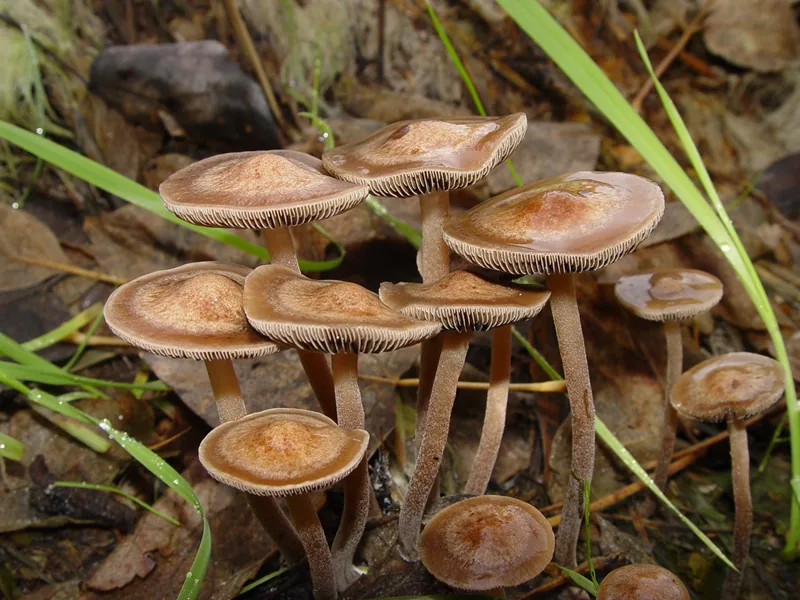
Panaeolus cinctulus
Banded mottlegill
A cosmopolitan, often weedy mottlegill found in lawns, compost and manured ground.
Regional status: Cosmopolitan; common on compost and dung across the UK and Europe
- Cap
- Reddish-brown, often with a darker marginal band while moist, fading paler as it dries.
- Gills
- Distinctively mottled brown-black from uneven spore maturation.
- Stem
- Slender and pale brown; bruising may be faint or absent.
- Flesh
- Thin, sometimes showing weak blue tones.
- Spore print
- Black.
- Habitat
- Manured soil, compost, straw, gardens and lawns; usually not directly on dung.
- Distribution
- Established in disturbed habitats in temperate and subtropical Australia and many other regions.
- Season
- Warm wet periods.
- Bruising
- Weak or inconsistent blue staining.
- Odour
- Mild or farinaceous.
- Potency
- Low to moderate and highly variable
Key features
- ▪Dark marginal band when moist
- ▪Mottled gills
- ▪Black spore print
- ▪Compost or manured-soil habitat
Field tests
- Confirm a truly black spore print
- Compare against brown-spored lawn mushrooms
- Do not rely on weak bruising
Edibility
Psychoactive reports and potency vary substantially; not a culinary mushroom.
Warning
Very difficult to distinguish from non-psychoactive Panaeolus and Panaeolina species without microscopy.
Photo and feature-based identification is probabilistic. Never consume a wild mushroom on the basis of an app result — confirm with an experienced mycologist.