Psilocybin-containingPluteaceaeUKEurope
Pluteus salicinus
Willow shield
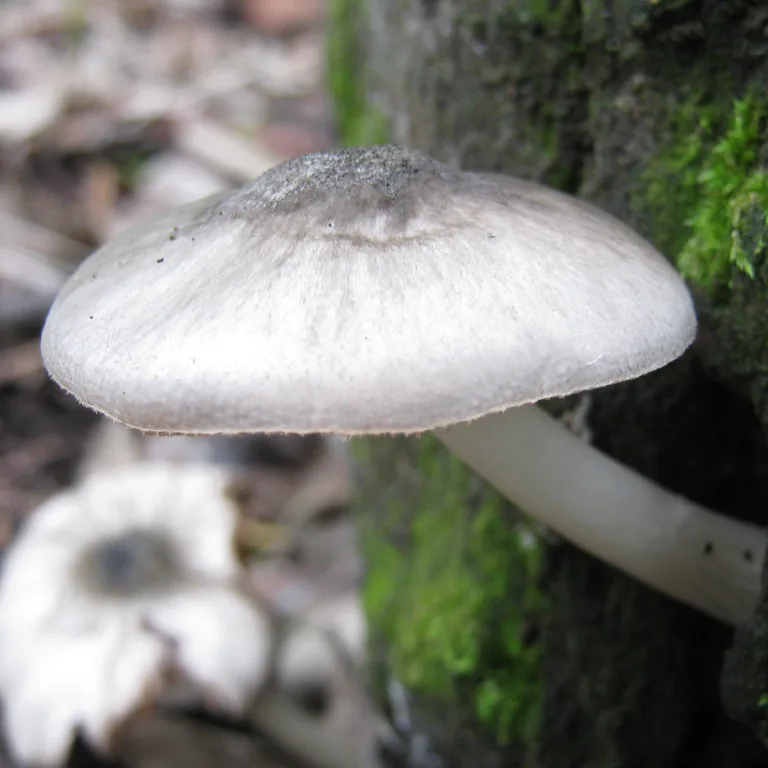
Woodland shield mushroom on rotting hardwood, with free pink gills and a weak psilocybin content.
Regional status: Native across the UK and Europe
- Cap
- Convex then flat, 20–70 mm, grey with a bluish or greenish tinge, finely scaly at the centre.
- Gills
- Free from the stem, white then pink as spores mature.
- Stem
- 35–80 mm, whitish to greyish, often greenish-blue at the base.
- Flesh
- White, sometimes blueing slightly.
- Spore print
- Pink to pinkish-brown
- Habitat
- Rotting deciduous wood, especially willow, alder, beech and elm, in damp woodland.
- Distribution
- Widespread across the UK, Ireland and continental Europe.
- Season
- June – November
- Bruising
- Faint blue-green at the stem base.
- Odour
- Radish-like
- Potency
- Weak
Key features
- ▪Free gills turning pink
- ▪Grows on rotting hardwood, never on soil
- ▪Pink spore print
Field tests
- Pink spore print rules out Psilocybe and Galerina
- Check gills are free, not attached to the stem
Edibility
Weakly psilocybin-containing; not a food species.
Warning
Other wood-rotting mushrooms in the same habitat are deadly. A pink spore print is essential confirmation.
Photo and feature-based identification is probabilistic. Never consume a wild mushroom on the basis of an app result — confirm with an experienced mycologist.