Psilocybin-containingHymenogastraceaeEuropeNorth America
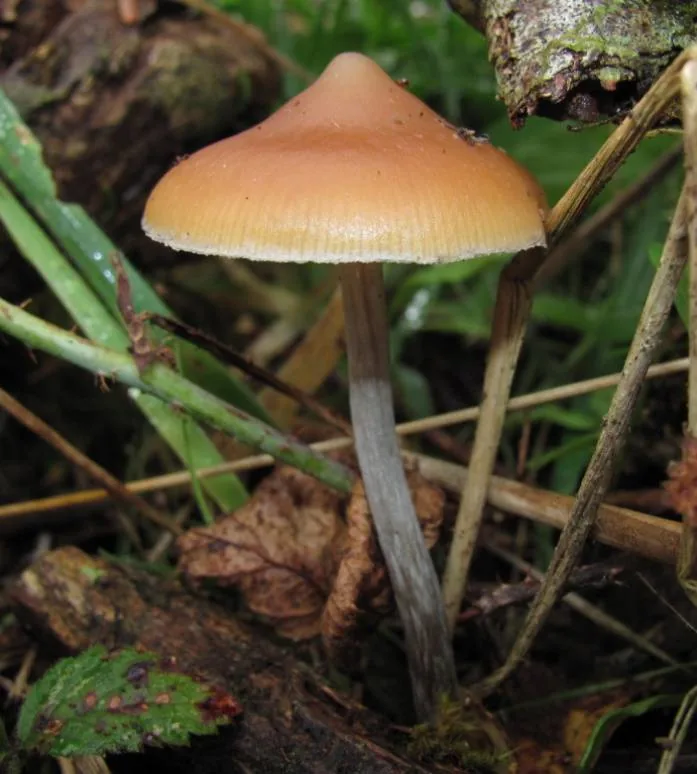
Psilocybe azurescens
Flying saucer mushroom
The most potent known Psilocybe, found on coastal dune grass and driftwood.
Regional status: Native to the US Pacific Northwest; naturalised in parts of Germany
- Cap
- Convex to flattened with a pronounced central umbo, 3-10 cm, caramel to chestnut, hygrophanic.
- Gills
- Adnate, pale cinnamon to dark purple-brown.
- Stem
- 90-200 mm, white, twisted, base thick and covered in white mycelium, bluing intensely.
- Flesh
- White, bruising deep blue-black.
- Spore print
- Dark purple-brown
- Habitat
- Sandy coastal soils, dune grass, driftwood and wood chips.
- Distribution
- Pacific Northwest coast of the USA, introduced in parts of Europe.
- Season
- Late September to January.
- Bruising
- Very strong, blue-black.
- Odour
- Farinaceous and bitter tasting.
- Potency
- Extremely potent
Key features
- ▪Pronounced pointed umbo
- ▪Very deep blue-black bruising
- ▪Coastal dune and driftwood habitat
Field tests
- Spore print must be dark purple-brown
- Look for the thick white rhizomorphic base
Edibility
Contains very high psilocybin, psilocin and baeocystin. Associated with temporary wood-lover paralysis.
Warning
Extremely potent; small dose differences matter. Galerina grows in the same wood debris.
Photo and feature-based identification is probabilistic. Never consume a wild mushroom on the basis of an app result — confirm with an experienced mycologist.