
Psilocybin-containingHymenogastraceaeMexicoCentral AmericaNorth America
Psilocybe caerulescens
Landslide mushroom
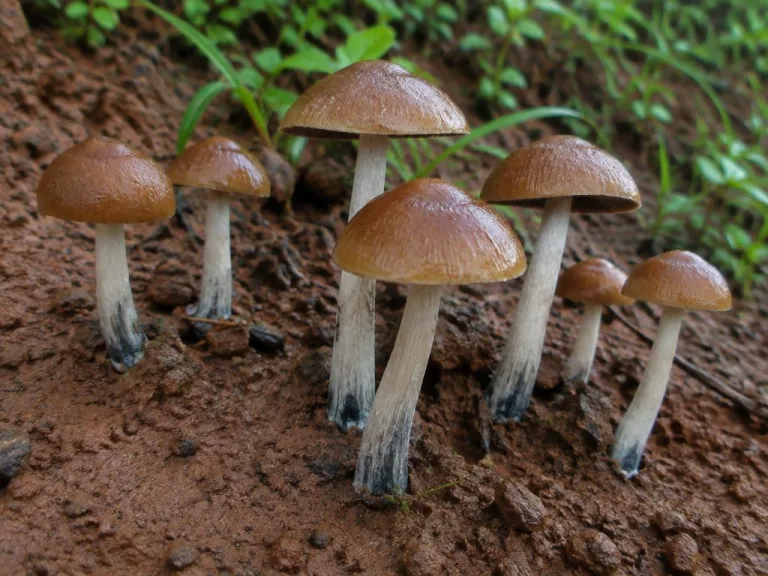
The Mesoamerican "derrumbe" of bare, disturbed soil; one of the species used in traditional Mazatec ceremony.
Regional status: Native to Mesoamerica
- Cap
- Convex then flattened, 20–80 mm, chestnut to straw brown, hygrophanous, margin often with thin veil remnants.
- Gills
- Adnate to adnexed, pale brown then deep purple-brown.
- Stem
- 40–120 mm, whitish and fibrillose, blueing where handled.
- Flesh
- Whitish, staining blue when cut.
- Spore print
- Dark purple-brown
- Habitat
- Bare clay soil on landslides, roadside cuttings and sugar-cane fields, without wood or dung.
- Distribution
- Mexico (Oaxaca, Veracruz, Puebla), Guatemala and the south-eastern United States.
- Season
- June – October (rainy season)
- Bruising
- Blue to blue-black on cap edge and stem.
- Odour
- Farinaceous
- Potency
- Strong
Key features
- ▪Grows on bare disturbed earth, never on wood
- ▪Fibrillose whitish stem
- ▪Blue-black staining
Field tests
- Confirm a purple-brown spore print
- Bruise the stem and wait 60 seconds for the blue reaction
Edibility
Psilocybin-containing; not a food species.
Warning
Several toxic brown-capped soil mushrooms share this habitat. Identification from a photograph is never sufficient.
Photo and feature-based identification is probabilistic. Never consume a wild mushroom on the basis of an app result — confirm with an experienced mycologist.