Psilocybin-containingHymenogastraceae
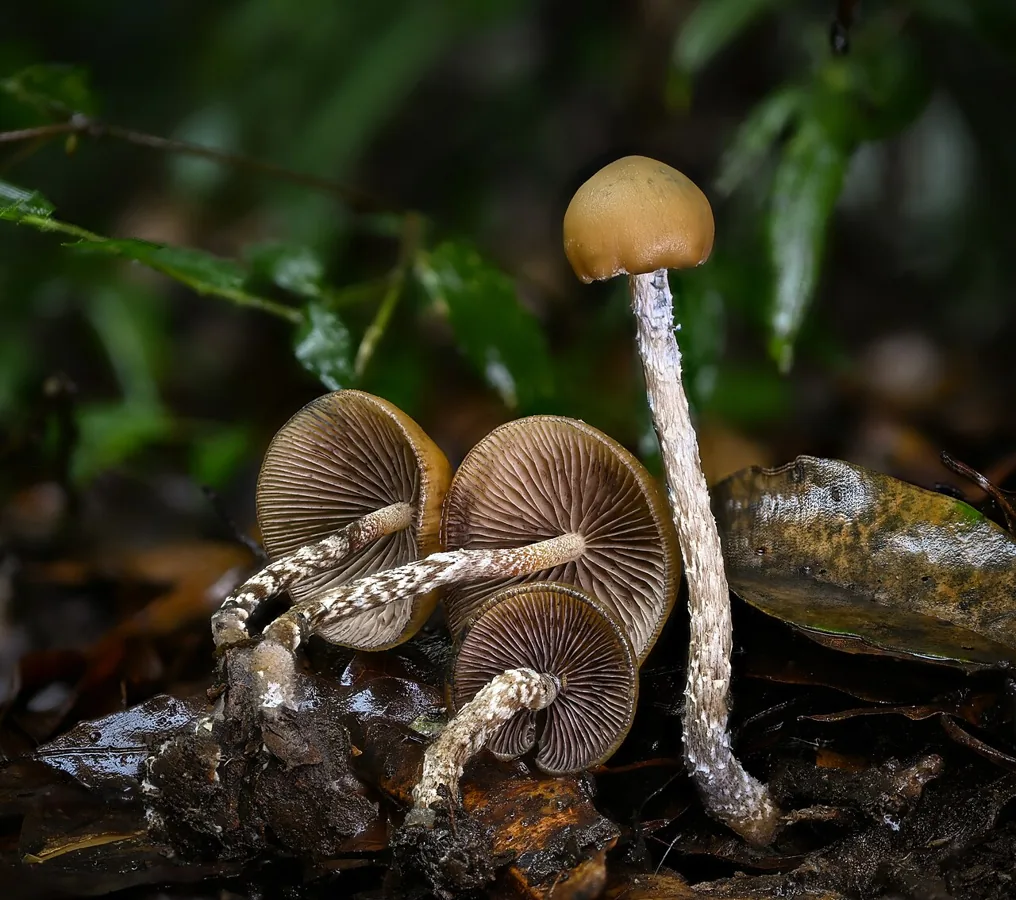
Psilocybe zapotecorum
Robust Latin American species of swampy ground, often clustered.
- Cap
- Convex to flat and irregular, 2-11 cm, whitish to yellow-brown, blackening blue where handled.
- Gills
- Adnate, whitish to dark purple.
- Stem
- 40-220 mm, often curved, whitish, bruising blue-black.
- Flesh
- Blue-black where cut.
- Spore print
- Dark purple-brown
- Habitat
- Wet, swampy soil and stream banks in subtropical forest.
- Distribution
- Mexico, Central and South America.
- Season
- June to November.
- Bruising
- Rapid blue turning almost black.
- Odour
- Farinaceous.
- Potency
- Potent
Key features
- ▪Bruises blue-black almost immediately
- ▪Swampy stream-bank habitat
- ▪Often grows in dense clusters
Field tests
- Spore print must be dark purple-brown
Edibility
Contains psilocybin.
Warning
Several white-capped tropical species are toxic; do not rely on colour alone.
Lookalikes
White Amanita speciesdeadly
Pale tropical Amanita have white free gills, a white spore print and a basal volva; zapotecorum bruises blue-black.
Photo and feature-based identification is probabilistic. Never consume a wild mushroom on the basis of an app result — confirm with an experienced mycologist.